
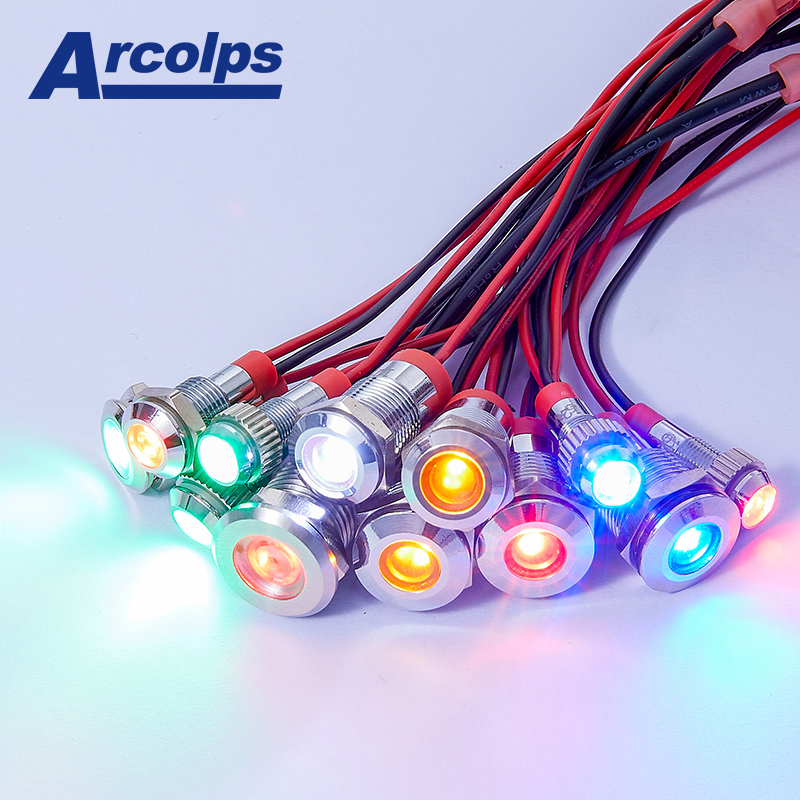
When you are designing a control panel for an automated production line, or perhaps an outdoor piece of machinery that needs to survive rain, dust, and extreme heat, one small component often gets overlooked: the indicator light.
But here is the reality: the moment that tiny light fails, your equipment essentially goes blind. Operators cannot tell if the machine is on, on standby, or has shut down with a fault. Downtime costs money, and maintenance crews get frustrated replacing the same burnt-out lights every few months.
So, how do you choose an industrial indicator light that actually lasts? And why do engineers worldwide keep turning to suppliers who hold UL and IP68 certifications?
Let us walk you through the technical checklist for selecting the right indicator light—and show you how Arcolps solves these headaches with real hardware.
1. Read the Fine Print: IP Rating vs. Temperature Rating
If your application lives outdoors, in a food processing plant, or anywhere near moisture, IP (Ingress Protection) rating is non-negotiable.
An IP67 rating means the light is dust-tight and can survive temporary immersion in water. IP68 takes it further—continuous submersion beyond 1 meter. For marine equipment or outdoor kiosks, you want IP68.
But here is the catch: a lot of cheap lights claim IP67 on paper but fail after a few months because the sealing ring degrades under high heat.
This is where high-temperature resistance kicks in. If your equipment generates ambient heat (like industrial ovens or engine compartments), regular plastic housings will warp, and moisture will seep in.
Tip from the factory floor: Always match the housing material to the environment. Metal housing + IP68 + UL certification is the trifecta for durability. Think of Arcolps’ 0012 Series Metal Indicator Lights—designed specifically for high-vibration, high-moisture scenarios. Check 0012 Series here
2. LED vs. Incandescent: Why the Switch Matters
Some old-school control panels still rely on incandescent bulbs. They are cheap upfront, sure. But they generate heat, burn out fast, and consume way more power.
LED indicator lights solve that.
-
Lifespan: 50,000+ hours (that is nearly 6 years of continuous operation) vs. 1,000–2,000 hours for incandescent.
-
Energy draw: LEDs use about 90% less power.
-
Heat output: LEDs run cool, which matters when you pack dozens of lights into a tight control panel.
Most industrial buyers have already switched to LED. But if you are still on the fence, consider the total cost of ownership: replacing an incandescent bulb every few months costs more in labor than just buying a quality LED light once.
Real-world example: A facility manager in Germany told us they switched their entire assembly line to Arcolps high-temp LED lights (0069 Series, UL certified) and have not replaced a single unit in over three years. See the 0069 Series
3. Voltage Compatibility: One Size Does Not Fit All
This is where engineers get tripped up.
Indicator lights come in various voltage ranges: 12V DC, 24V DC, 110V AC, 220V AC, and even wide-range models that handle 110–250V.
If you are working with exported machinery, voltage standards vary by country. You do not want to stock separate SKUs for the US (110V) and Europe (220V) if you can help it.
That is why many OEMs prefer wide-voltage LED indicators. They simplify inventory and reduce the risk of someone installing the wrong light on the line.
Arcolps offers flexible voltage options across our entire lineup—from low-voltage electronics to mains-powered industrial panels. Explore full specifications here
4. Certifications: UL, CE, RoHS—Why They Matter for Export
Here is a hard truth: if your machinery is headed to North America or Europe, your indicator lights must carry proper certifications. Otherwise, your entire product may fail compliance inspection at customs.
-
UL / c-UL : Required for industrial equipment sold in the US and Canada.
-
CE : Mandatory for Europe.
-
RoHS & REACH : Environmental compliance for hazardous substances.
A supplier who cuts corners on certifications is a liability. Arcolps holds UL, c-UL, ENEC, KEMA, CCC, CQC, KC, PSE, CE, CB, ISO9001, RoHS, and REACH. We are not just selling lights—we are selling compliance so you can ship anywhere without surprises. Read about our certifications
5. Mounting Style: Panel Mount vs. PCB Mount
Do you need the light to sit on the front panel for operators to see, or are you integrating it directly onto a circuit board?
-
Panel-mount indicator lights : Larger, easier to see from a distance. Best for control stations and machinery exteriors.
-
PCB-mount indicators : Tiny, low-profile. Used inside consumer electronics or compact medical devices.
Most industrial applications lean toward panel-mount metal or plastic bodies. Metal gives you mechanical strength (good for high-vibration environments like vehicle dashboards). Plastic is lighter and often sufficient for indoor control cabinets.
Our 0160 Series offers high-temp waterproof plastic housing with IP67 protection—a popular choice for food processing equipment where washdowns are routine. Check 0160 Series
6. Real Talk: Why Global Buyers Choose Arcolps
We are a manufacturer based in Shenzhen, China, with global headquarters in Hong Kong. That means you get factory-direct pricing without middlemen markups.
But price is only half the equation. Here is what our customers actually value:
-
20+ years in R&D and manufacturing—we have seen every application imaginable, from coffee machines to medical devices.
-
Customization : Need a specific color, a different voltage, or even a logo on the housing? We handle custom orders with fast turnaround.
-
Global shipping : We work with buyers in North America, Europe, Southeast Asia, and the Middle East. Your order gets where it needs to go.
“Arcolps‘ indicator lights have significantly improved the reliability of our automated systems. Their durability and clarity are unmatched.” — Travis Duder
“We trust Arcolps for their UL and ENEC certified push button switches. Their commitment to quality ensures our products meet global standards.” — Maria Lopez
The Bottom Line
Selecting the right indicator light comes down to four questions:
-
What is the environment? (Water, dust, heat, vibration?)
-
What voltage does your system run on?
-
What certifications do you need for export?
-
Do you want to replace lights every year—or every decade?
LED technology has made the answer clear. And with a reliable partner like Arcolps handling UL certifications and high-temperature durability, you can set up your control panels and forget about them.
Ready to upgrade your industrial indicators? Browse our full collection here or contact us directly at info@arcolps.com for custom quotes and bulk pricing.