
How to Choose Industrial Push Button Switches and Indicator Lights: A Complete Selection Guide
In industrial automation and control panel design, small components often carry the most significant responsibilities. Industrial push button switches and indicator lights serve as the primary interface between human operators and complex machinery. Selecting the wrong specification can lead to costly downtime, safety hazards, or premature component failure.
Whether you are a procurement manager sourcing for an OEM project or an electrical engineer designing a new control panel, this comprehensive guide will walk you through the critical factors required to choose the perfect pilot devices for your application.
1. Understanding the Core Differences: NO vs. NC Contact Blocks
When specifying an industrial push button switch, understanding the contact block configuration is the absolute foundation. Mechanical switches rely on these contacts to open or close an electrical circuit.
-
Normally Open (NO): The circuit remains open (off) until the button is pressed. These are typically used for Start functions (like the "UP" or "DOWN" actions in a standard control station).
-
Normally Closed (NC): The circuit remains closed (on) until the button is pressed, which breaks the circuit. This is mandatory for Stop or Emergency Stop (E-Stop) functions to ensure immediate power disconnection.
2. Critical Selection Factors for Industrial Environments
To ensure your components survive harsh factory floors or outdoor environments, you must evaluate three primary technical dimensions:
A. Ingress Protection (IP Ratings)
Industrial environments are plagued by dust, oil, and moisture. Choosing the correct IP rating determines the lifespan of your switches and indicator lights:
-
IP65: Dust-tight and protected against water jets. Ideal for standard indoor control panels.
-
IP67 / IP69K: Protected against temporary immersion and high-pressure, high-temperature washdowns. Essential for food processing, pharmaceuticals, and marine applications.
B. Mounting Hole Diameter
Standardization simplifies panel building. Most industrial panels use standard cutout sizes. Ensure you match your panel layout with the correct component diameter:
-
16mm / 19mm: Perfect for compact control boxes, medical equipment, or space-constrained interfaces.
-
22mm: The global industry standard for standard heavy-duty industrial control panels.
-
30mm: Heavy-duty applications, often preferred in rugged environments where operators wear thick gloves.
C. Actuator Types and Functionality
The physical shape of the button dictates its operational purpose:
-
Flush / Extended Buttons: Used for everyday start/stop cycles.
-
Mushroom Head (Latching): Typically reserved for Emergency Stop buttons. They require a "twist-to-release" or "pull-to-release" action to reset, preventing accidental restarts.
-
Selector Switches: Maintained or momentary knobs used to switch between different operational modes (e.g., Manual vs. Auto).
3. Industrial Indicator Lights: LED vs. Incandescent and Color Coding
Modern industrial indicator lights have almost completely transitioned to LED technology due to its 50,000+ hour lifespan, low power consumption, and vibration resistance. However, the most critical aspect of pilot light selection is adhering to international safety standards (such as IEC 60204-1) for color coding.
| Lens Color | Meaning / Standard Usage | Example Application |
| Red | Danger / Fault / Emergency | Emergency stop activated, system failure, or high temperature. |
| Yellow / Amber | Abnormal / Caution | Abnormal condition developing (e.g., minor overload or pressure limit reached). |
| Green | Safe / Normal Operation | Machine ready running normally, or cycle completed successfully. |
| Blue | Mandatory Action Required | Operator intervention needed (e.g., fluid replenishment required). |
| White / Clear | General Information | Power on, system monitoring, or neutral status indicator. |
4. Sourcing and Customization: Why Partnering with Arcolps Matters
For B2B buyers, finding a reliable industrial switch manufacturer goes beyond looking at a spec sheet. When sourcing indicator lights and push button switches in bulk, you should look for partners that offer compliance, custom laser-etching, and robust material options.
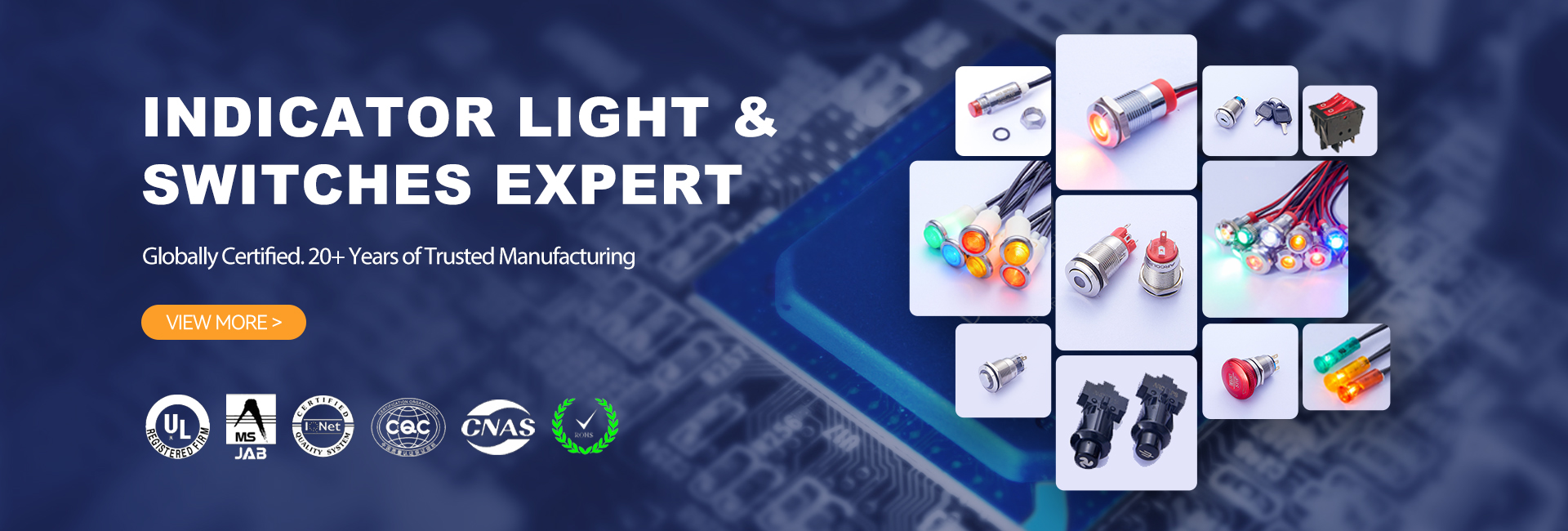
At Arcolps, we specialize in high-quality industrial automation components designed for extreme operational environments. Our product lineup includes:
-
Precision Engineered Indicator Lights: Available in various voltages, high-brightness LED configurations, and multiple mounting diameters to fit any control panel setup.
-
Heavy-Duty Push Button Switches: Ranging from anti-vandal metallic options to modular plastic switches with versatile contact blocks (NO/NC) tailored for your engineering schematics.
Conclusion
Selecting the right industrial components is a balance between understanding your electrical requirements and assessing the physical environment they will operate in. Investing time in accurate specification prevents premature component failure and guarantees a safer, more efficient user interface.
Ready to optimize your industrial control interfaces?
Browse Arcolps' comprehensive collection of premium Indicator Lights and rugged Push Button Switches. Contact our technical support team today for detailed engineering datasheets, volume pricing, and custom OEM/ODM solutions.